
Veneer hardcoat is a high-density lime and gypsum plaster system specified when a wall has to carry cast ornament, run moldings, or hard daily use without giving way. Two thin coats over a bonded base build a monolithic surface that takes detail, impact, and finish coats most boards cannot.
It is the wall most people never look at directly. Specifiers reach for it when something else (a run cornice, a ceiling rose, a deep base reveal, a wall-mounted handrail) has to land on plaster and stay there. The finish coat is what guests see. The hardcoat is what holds.
The finish in plain language
Veneer hardcoat is not a decorative finish in the way that Venetian or marmorino are decorative finishes. It is a substrate-and-body system. A bonded base coat goes onto blueboard or a similar lime-tolerant board, and a hardened finish coat goes on top. The finished thickness sits in the range of three to four millimeters total: thin compared to a traditional three-coat lime plaster, dense compared to a skim of joint compound.
People confuse it with two adjacent things. The first is conventional veneer plaster, which is a single thin gypsum skim used to flatten board for paint. That is a cosmetic system. Veneer hardcoat is a structural one: the body is engineered to a higher compressive strength, and the base coat is graded to bond mechanically rather than just chemically. The second is full three-coat lime plaster, which goes onto wood or metal lath and runs eight to twelve millimeters thick. Hardcoat sits between those two: dense enough to act like a real wall, thin enough to go on a modern board substrate without rebuilding the framing.
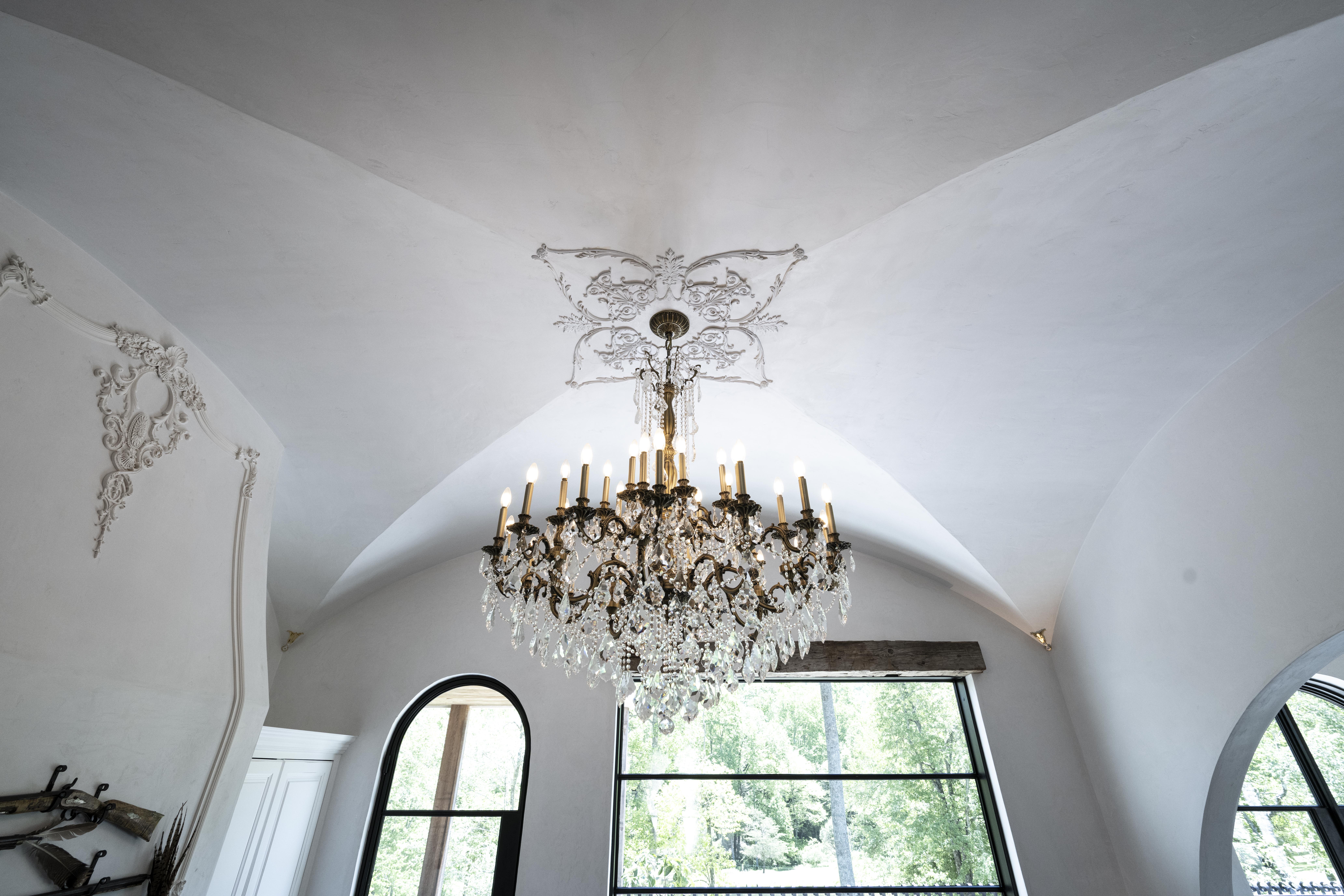
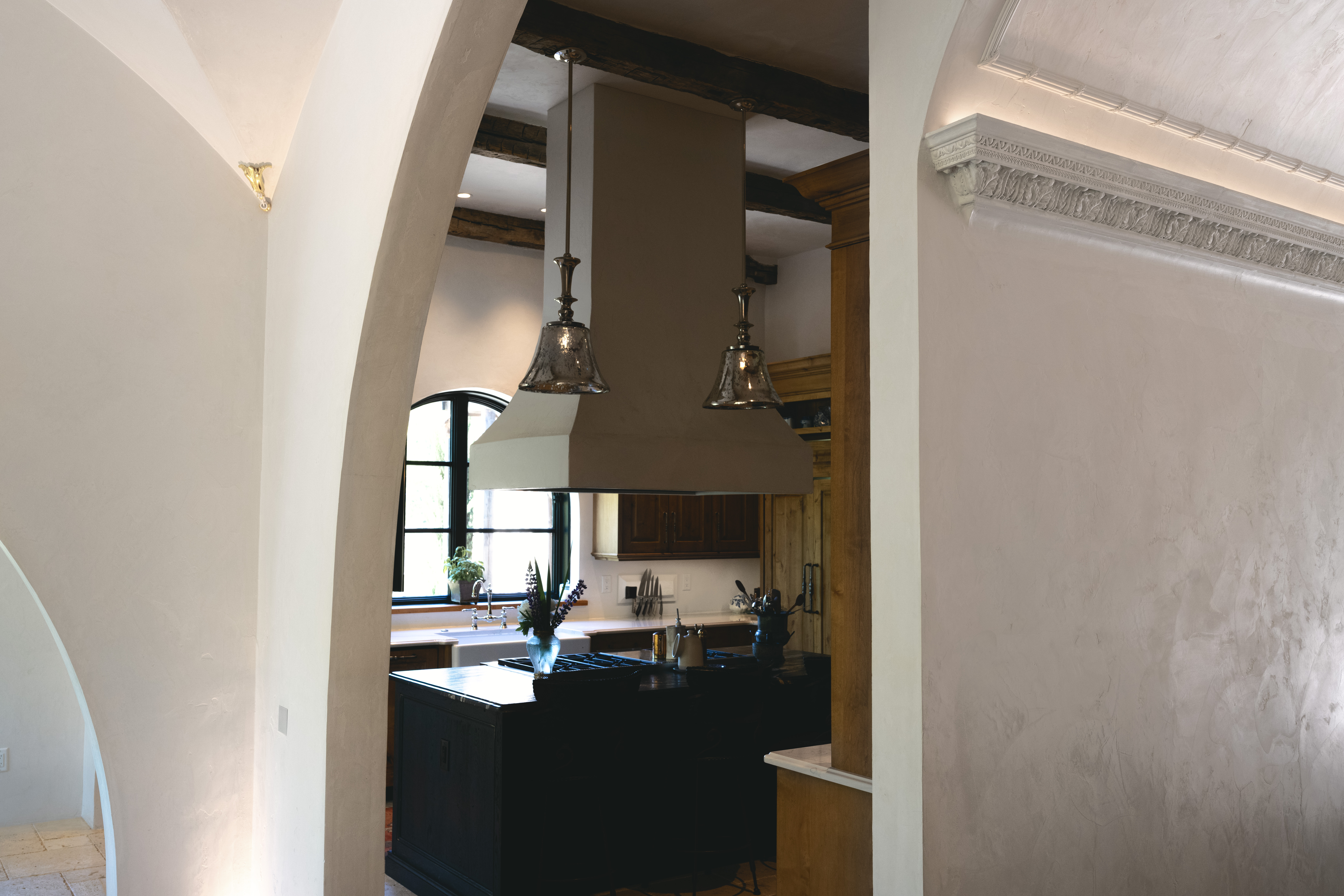
The reason to specify it is almost always downstream. A drawing calls for a run cornice along the perimeter of a great room, or a ceiling rose at the center of a foyer, or a chair rail and panel-molding scheme through a corridor. None of those details belong on painted drywall. They want a host wall that will hold a fastener, accept a bonding coat, and resist the hairline cracking that ornament telegraphs through a softer surface.
The project anchor
A hospitality residence in Central Florida ([[project_name]], [[year]]). The brief from the architect ([[architect]]) called for a great room, gallery corridor, and primary suite finished with run cornices, applied pilasters, and a coffered ceiling field that read as one continuous plaster envelope. The interior designer ([[interior_designer]]) wanted the body of the walls to take a hand-burnished lime topcoat, with the cornice and ceiling rose work pulled from cast and run profiles drawn for the house.
The site presented the conditions that push specifiers toward hardcoat in the first place. New construction over a steel-and-wood hybrid frame. Standard interior board substrate already detailed by the GC. Long uninterrupted wall runs ([[square_footage]] approximate field) where any movement in the substrate would broadcast straight into the moldings. A coastal Florida humidity and temperature swing across the build calendar. And the ornament itself, which had to land flush against a perfectly plumb wall plane with no daylight at the back of a cornice return.
We pulled the board scheme back to a continuous blueboard underlayment across the great room and gallery, replacing the GC’s original mixed-board layout in those rooms with one specified for lime-tolerant veneer work. From there the wall was a two-coat hardcoat: a bonded base coat troweled tight to the board, scratched while green for mechanical key, and a hardened finish coat brought up the next morning to a flat, dense, ready-to-receive plane. The cornice was run in place after the body had cured, with the run profile carried in two passes (a roughing pass to mass the form, a finishing pass to bring the arrises). The ceiling roses were cast off site from the same hardcoat mix and bonded back into the field with a lime slurry, then point-finished where the seam met the body.
The body topcoat (a lime-putty finish coat outside the scope of this article) went on last. The hardcoat does not show in the final frames. What shows is a cornice that meets the wall at a sharp arris, a rose that reads as part of the ceiling rather than glued to it, and a wall plane that holds the topcoat without telegraphing seams.
Material and method
The base coat is a lime-rich gypsum body, gauged with a graded silica aggregate, mixed to a stiff working consistency, and applied at roughly two millimeters over a bonded blueboard substrate. The aggregate is what does the structural work. A finer grade than a brown coat, a coarser grade than a skim. It is what lets the base accept the load of a run cornice or a cast rose without crushing or releasing at the bond line.
The finish coat is a hardened lime and gypsum top, applied wet-on-firm over the base while it still has moisture in it but after it has taken its initial set. The discipline is in the timing. Too early and the two coats slump into one another and lose their layered strength. Too late and the bond between them becomes mechanical rather than monolithic, which shows up later as hairline cracks at stress points. The right window on a typical Central Florida job in late spring is roughly four to six hours between coats, watched by hand rather than by clock.
The system likes a substrate that has been thought about. Blueboard with taped and base-coated joints, fastener heads tight to plane (not driven proud), corners reinforced at outside returns, and a clean inside corner where the wall meets the ceiling so the run profile has something flat to register against. Where the substrate is older or mixed, the system tolerates a bonding agent at the base, but the assumption should be a board chosen for the work, not the work fitted to a board chosen for something else.
What separates the hardcoat from a limestone plaster or a marmorino is the role it is asked to play. Limestone plaster is an interior body finish, slow to cure, soft enough to burnish into long sweeps of trowel light, and at home over an absorbent base. Marmorino is a decorative topcoat, pulled into a polished or matte surface depending on the room. Neither is meant to host a run cornice on a thin board substrate. Hardcoat is. It sits at the structural end of the lime family: a wall that earns the right to carry detail.
Where it works, where it does not
Hardcoat belongs in any room where the architectural detailing is structural rather than applied. Foyers and great rooms with run cornices. Hospitality lobbies where moldings carry across long uninterrupted runs. Residential corridors with panel-molding schemes that have to land plumb over twenty feet. Library and dining rooms with applied pilasters or chair rails that are being run, not bought. It is also a sound choice for high-traffic walls in private hospitality where impact resistance matters and a softer body would dent.
It does not belong on exterior assemblies. It is not waterproof, and it is not a substitute for an exterior stucco or an EIFS system. It does not belong in wet rooms (showers, steam rooms, splash zones) without a separate waterproofing strategy ahead of it. And it is not the right call when the ornament in question is purely cosmetic and could be carried by a lighter system: spending a hardcoat budget on a wall that is going to be flat-painted with a single applied moulding is overbuilding.
The system is also unforgiving of substrate movement. A wall that flexes will crack a hardcoat, eventually, at the points where the cornice or rose has stiffened the assembly. Where movement is unavoidable (long uninterrupted runs across a structural break, for example), the design has to include control joints, and those joints have to be carried through the molding scheme rather than hidden under it.
Cost reality
Hardcoat is not the cheapest plaster system per square foot, and it is not the most expensive either. It sits in the middle of the lime family on a body-coat basis, but the real cost driver is rarely the body. It is the ornament the body is being installed to carry: the cornice run, the cast rose count, the sample-board cycle for the topcoat, the number of corners and returns the run profile has to negotiate. A great room with a single perimeter cornice is one number. The same room with a coffered ceiling and applied pilasters at every bay is several times that.
Against painted drywall, the comparison is not square-foot price. It is whether the moldings the drawing calls for can survive on a board wall over a fifteen to twenty year residential life. In our experience they cannot, and the cost shows up later, in remedial work that is more expensive than building the wall correctly the first time.
Specifying it
What an architect writes into a drawing for a hardcoat system: the finish name (veneer hardcoat plaster, two-coat), the substrate (continuous lime-tolerant blueboard, joints taped and base-coated, fastener heads flush), the finished thickness range (three to four millimeters body), the topcoat (called out separately, with sheen target and sample-board sign-off requirement), and a note that any cast or run ornament is to be installed on the cured hardcoat, not on board. A sample board against site light, signed off by the architect and the principal, lands the topcoat. The hardcoat itself is a substrate spec, not a finish spec, and should be drawn as such.
Start with a conversation. Send us the drawing set and the rooms the moldings are landing in, and we will walk back from there to the substrate. Contact the studio.