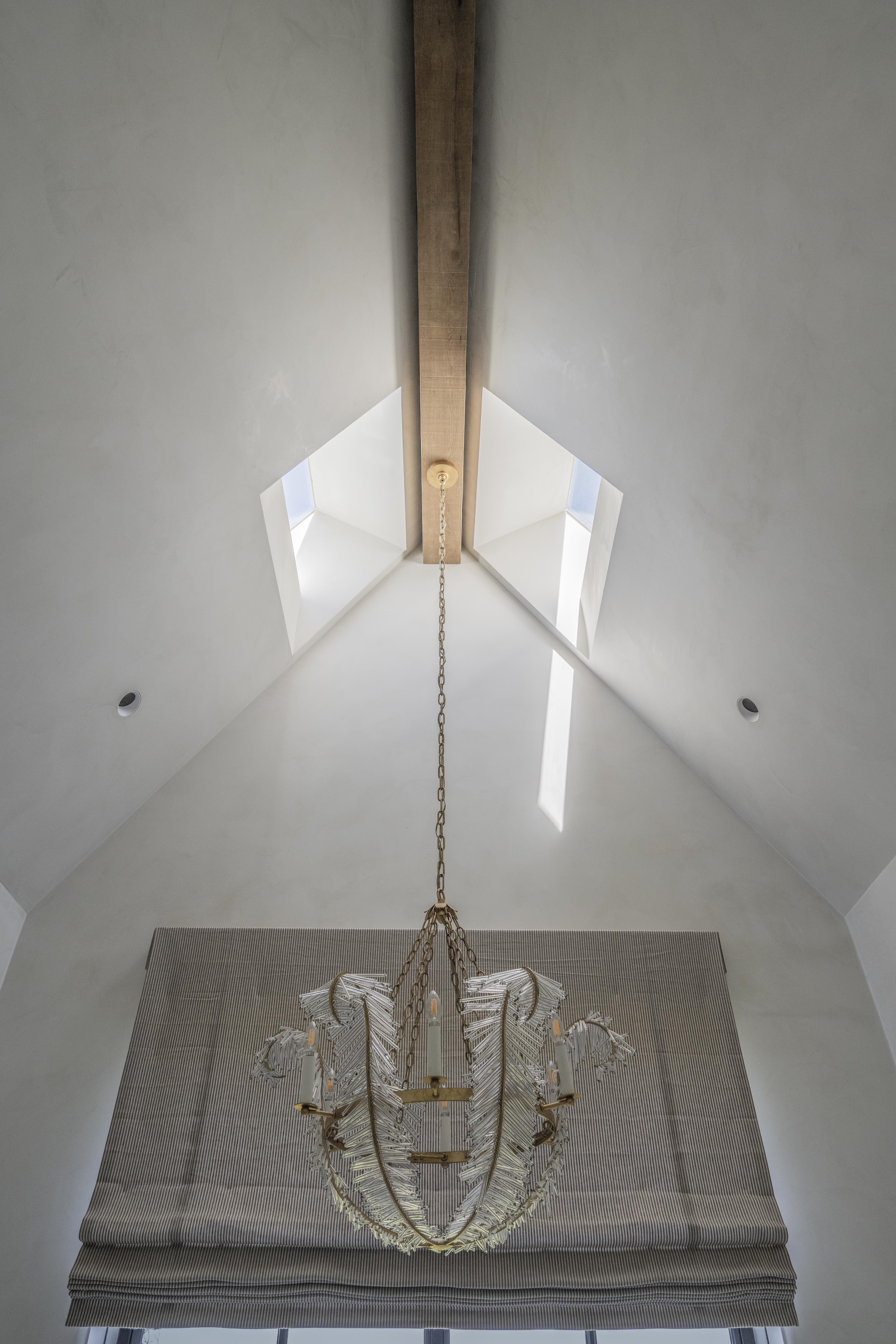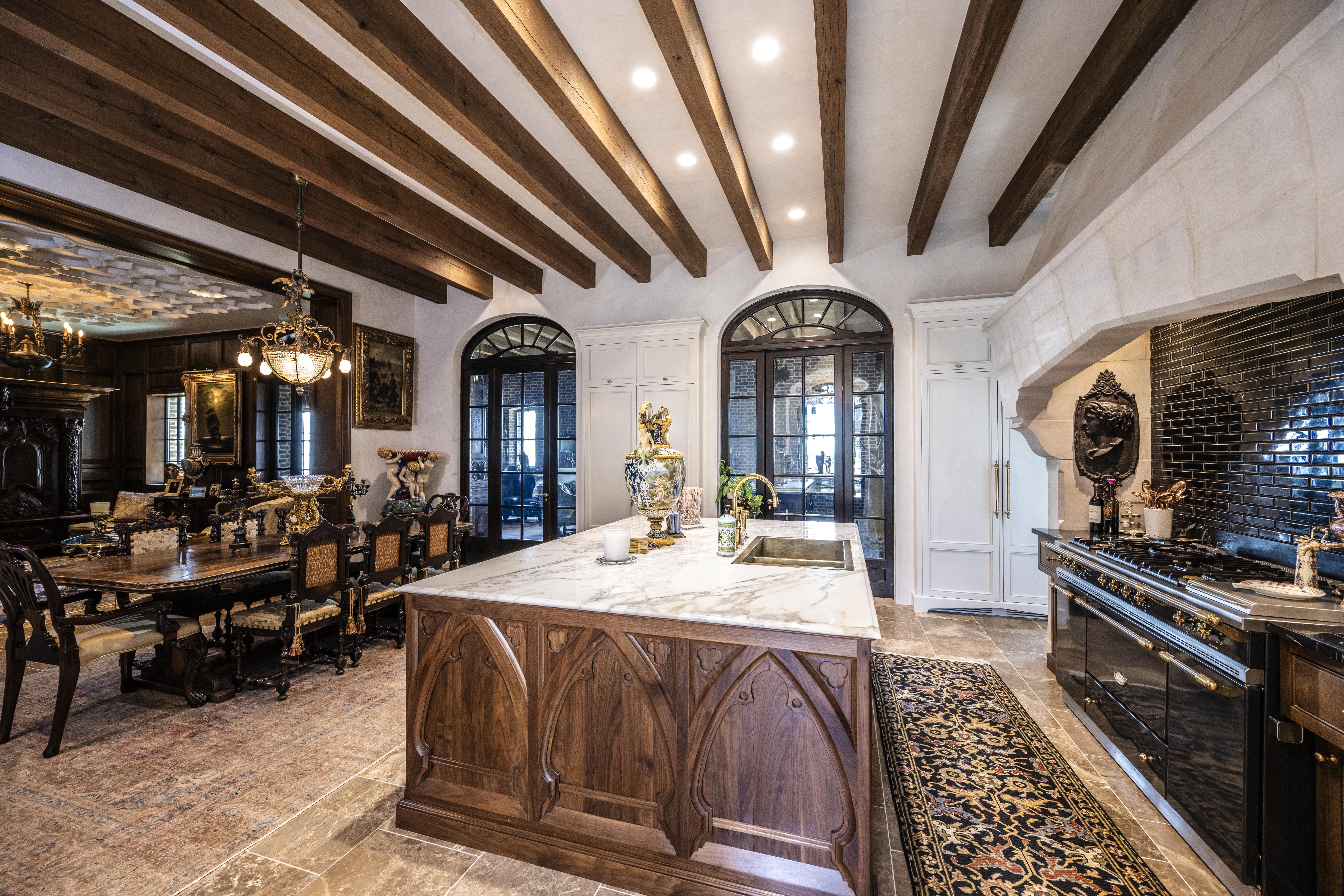

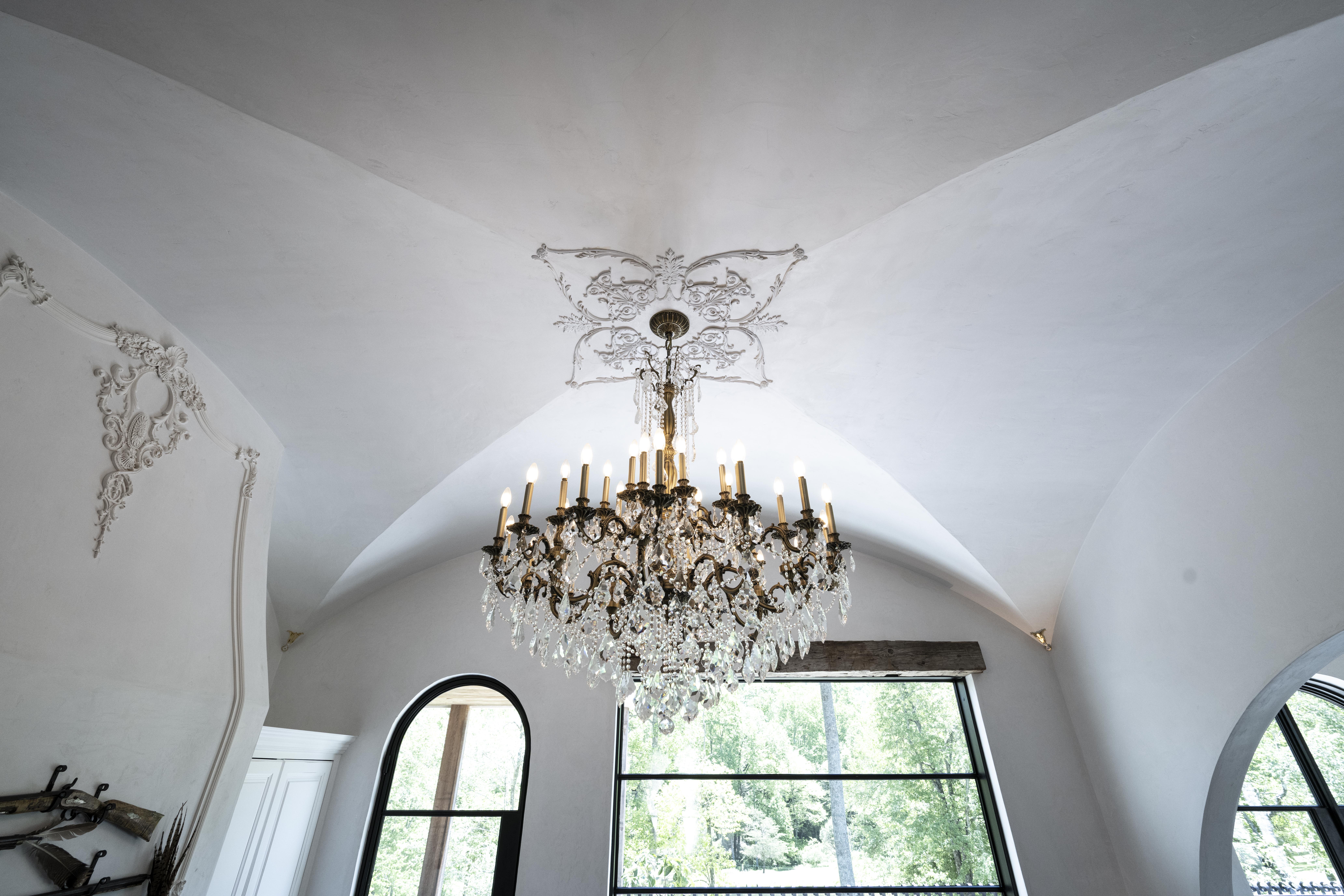
Plaster moldings are ornamental and architectural profiles made from lime or gypsum plaster, either cast in a shop, run in place on a horsed template, or hand-modeled. Specify them when the room calls for ornament that reads as part of the wall.
The finish in plain language
A plaster molding is the same wall, continued into a profile. The cornice that breaks the ceiling, the rose that anchors the chandelier, the chair rail that returns around a dining room, the base reveal at the floor, the panel surround that frames the field. Where a flat wall ends, a plaster molding picks the line up and carries it into three dimensions, using the same mineral material the wall is made from.
That is what separates a real plaster molding from an applied trim made of polyurethane, MDF, or pressed paper. Those products solve a different problem. They give a builder a quick way to suggest the profile of an ornament without the trades, the time, or the cost of running one. They sit on the wall. A plaster molding is the wall, shaped. It cures continuous with the field, holds light the way the body plaster does, and ages on the same schedule as the rest of the room. When an architect asks for ornament that does not announce itself as a separate object, this is the answer.
A Federal residence and a ceiling rose: the project anchor
The hypothetical here is a Federal-style residence in [[CONFIRM region, e.g., Charleston SC or the Virginia Piedmont]], built in [[CONFIRM year]] and brought back over a [[CONFIRM]]-month interior restoration. The commission carried plaster moldings across the main floor: a run cornice in the entry and parlors, a cast ceiling rose under the parlor chandelier, a chair rail returning the dining room, base reveals through the public rooms, and pattern-matched panel surrounds in the stair hall. The brief was to restore the lost ornament where the originals had been removed in a mid-century renovation and to extend the language into rooms that had never carried it, without the new work reading as a copy.
The original profiles were measured from intact survivors at the cornice returns in the back parlor and from a single original rose in the dining room. Architect of record is [[CONFIRM]]. Interior designer is [[CONFIRM]]. Survey, template draw, and a shop mockup preceded any site work. Sample sign-off happened in the room under the room’s actual light, with the architect and owner reviewing the cornice profile in raking afternoon light before a single horsed run was set against the wall.
Photography on the project documents the work as it lives in the room. Wide elevations show the cornice carrying around the parlors as a single continuous shadow line. Detail frames show the rose centered under the chandelier, the rope course of the chair rail returning into the corner of the dining room, and the panel surrounds catching the side light from the long windows. The intent is the same as on every commission: a frame is not a swatch. A profile only tells the truth when raking light hits it under the room’s real conditions.
Material and method
The studio works in two material families for plaster moldings. Lime plaster for run-in-place work, ornamental fields continuous with body plaster, and most exterior or breathable applications. Gypsum plaster, sometimes blended with retarders and fibers, for shop-cast pieces destined for interior installation: ceiling roses, repeating cornice sections, brackets, and panel ornament. Each has a place. Lime is slower, breathable, and stays alive with the wall it sits on. Gypsum is faster, harder, and takes a sharper detail off a mold, which is why historical pattern books for cast interior ornament generally specify gypsum.
Three fabrication methods cover the work, and a single commission usually carries all three.
Run in place is the traditional method for a continuous profile. A horse (a wood-and-zinc template cut to the exact reverse of the profile) is dragged along a fixed guide rail in repeated wet passes. Each pass adds material and refines the profile. The cornice grows out of the wall, married to it from the first pass. There is no seam between the molding and the field because both are the same coat sequence at the joining course. Run in place is the right choice when the profile is continuous, the substrate is sound, and the schedule allows the lime to set between passes.
Shop casting is the right method for repeated discrete ornaments: ceiling roses, repeating brackets, modillions, dentils, drops, swags. Casting begins with a master, either modeled by hand from a survey or pulled from an original surviving piece. A flexible mold is taken from the master, usually in a silicone or gelatin formula chosen for the relief depth and the undercut of the ornament. Casts are pulled, cured, trimmed, and brought to the room. Attachment is mechanical and adhesive: stainless or brass screws into solid blocking through pre-drilled bosses on the back of the cast, plaster of Paris or a lime adhesive at the bedding face, joints pointed and finished continuous with the field plaster after the cast is set.
Hand modeling is the third method, used where the ornament is unique, where the profile cannot be horsed because it changes along its run, or where a piece of original ornament needs to be matched in place rather than removed and re-cast. Hand modeling is slow. It is also the only way to honor a one-off survivor without losing the maker’s hand. Pattern matching for restoration begins here. A scrap of original cornice off the back parlor returns becomes the reference for the run on the front parlor. A surviving rose half is reconstructed across its missing axis by hand before the master is cast.
Where it works, where it does not
Plaster moldings work in any interior where the architecture supports ornament: Tudor revival, Federal, Greek revival, Victorian, Italianate, Beaux-Arts, Colonial revival, and a growing share of contemporary residential work that wants the depth of a real cornice without the period vocabulary. They work on sound substrates: brown coat over lath, well-detailed gypsum board with mesh-reinforced scratch coat at run-in-place locations, and solid blocking at every cast attachment point. They are happy across the public rooms of a house. A cornice in a stair hall lifts the ceiling. A ceiling rose under a chandelier finishes a room that without it reads incomplete.
They are the wrong call without the blocking. Cast ornament cannot hang off a single layer of paper-faced board, and any spec that does not name the blocking and the attachment system is a spec that will fail at install. They are also the wrong call in wet rooms without a separate strategy. A shower or a steam room needs Tadelakt or a true waterproofed assembly, and any ornamental surround in those rooms needs to be detailed at the assembly level, not added at the finish level. Climate matters: in the studio’s Central Florida work, gypsum casts hold up well indoors but are protected from envelope-condition exposure, and exterior ornament moves to lime-based formulas with a deliberate weathering strategy.
Cost reality
Plaster moldings do not price like trim. They price like a piece of the building. Variance comes from a short list of inputs: the number of unique profiles, the length of run for each, the count of repeated cast pieces, the depth of relief on the ornamental work, and whether the work is pure restoration (matching extant profiles), pure new (no reference), or hybrid. Pattern matching adds survey time and template work. Run-in-place is a daily-rate trade once the profile is drawn. Shop casting compresses the per-piece cost as the run count grows.
The framing that matters is not against polyurethane trim. It is against the life of the room. Real plaster moldings do not separate from the wall, do not yellow under heat, and do not telegraph their seams in the second summer. They age the way the room ages. That is the comparison an architect should write into the value section of the spec.
Specifying it
A clean plaster molding spec names six things: the profile (with a measured drawing, scaled, with returns and miters detailed), the method (run in place, shop cast, or hand modeled), the material (lime or gypsum, with the binder named), the substrate and blocking (lath, mesh-reinforced scratch, or solid blocking sized to the cast weight), the attachment system (mechanical fasteners with pre-drilled bosses, bedding adhesive, pointed joints), and the sample sign-off (mockup of one bay of cornice and one cast piece, reviewed in the room under raking light, signed off by architect and owner before the full run begins).
The studio runs the mockup pass in the room when the schedule allows it, because the profile that reads correct in the shop can read flat on the wall, and the only way to know is to set it under the room’s own light. Sample-board approval is the gate that protects the project from a profile that looked right on paper and wrong in place.
A real plaster molding is not a piece of trim glued to a wall. It is the wall, shaped. Plaster by Orciani has been running and casting ornamental plaster since 1981, second-generation, out of Asheville. Start with a conversation. Contact the studio.